

This year, to celebrate our return to the Ruins for live theatre after two seasons away, SIR will offer TWO productions playing in repertory – alternating on selected dates – between June 02 and July 02: Much Ado About Nothing, directed by SIR-founder Ann Hodges, and the solo play The Player King, a “hilarious new tragedy”, written and directed by national comedy star Ron Pederson, and starring Rodrigo Beilfuss. Much Ado About Nothing is one of Shakespeare’s most delightful comedies, featuring two of his best quarreling lovers, Beatrice and Benedick – who passionately quibble their way into falling madly in love in a world of misinformation, fake news and dangerous lies. In The Player King, a travelling Shakespearean actor finds himself facing an opening night audience without his company, setting off an existential crisis of tragic proportions. Can the show go on? Should it? Compelled by the power of storytelling, he attempts to deliver a solo version of Hamlet, but something is deeply amiss as fantasy and reality start to blend in this celebration of theatrical obsessions, and the quest for the performance of a lifetime…even to the edge of doom. Our Artistic Director, Rodrigo Beilfuss, interviewed both directors ahead of rehearsals. Read on to get a glimpse of their process as they prepare to bring these two shows to life.

Q: Ron, you’re a celebrated comedy man, from sketches on TV to improv to musicals…you have comedy in your bones. Can a text like Shakespeare’s still be funny, really funny, 4 centuries later? A: Shakespeare is funny in so many different ways; in a way, he was an improviser, using everything in his arsenal to keep those big plays full of variety and surprise. And there are things in it that are situational and hilarious, as in the Merry Wives of Windsor, where he sets up these situations that I think still resonate: a husband in hiding from his wife, mistaken identities; those things are still being used on television and Netflix. So ultimately yes, I think he is funny. But he’s also funny in a lot of linguistic ways, with his malapropisms and inventive words and expressions that can really date over time, which can be challenging. It’s cliché to say this, but there’s something for everybody in Shakespeare. The clowns in Shakespeare are really difficult and challenging because of those old jokes, and to lift them off the page now can sometimes feel like ‘oh God here comes that 400 year old joke, here we go’. I ran into that playing Launcelot Gobbo. And on top of that, some of those jokes are just plain racist. So, the long answer is: it all really depends on who’s directing the show, and who’s acting. I think Shakespeare is funny, but it takes dedicated artists to really figure things out. You really have to know why it was funny in the first place, and you need to know what a modern audience would be hearing now. There’s a science to it. Q: What’s harder to do, a Shakespearean tragedy or comedy? Why? A: Comedies are harder – whether it’s by Shakespeare or not. Comedies in general are much harder. You have to know why something is funny beforehand; you have to have a specific relationship with the audience with a lot of these comedies, and that’s where those clowns can be made or broken. There’s a science involved in comedy–not just a heart and emotion. You actually have to really consider the music of the comedy, where punchline lands, where the audience should laugh; you must consider things much more carefully–as opposed to just surrendering to it and going with your feelings. Q: What’s your biggest pet peeve with contemporary trends in staging Shakespeare, and in particular the comedies? A: I find that every play by Shakespeare has comedy in them, even the tragedies, otherwise it would be unbearable. Even Romeo and Juliet has a lot of comedy in it – it’s all very playful. And you have to find the playfulness inside of it all. I think that if Romeo and Juliet don’t laugh together, or at least recognize that they’re playing and playing with words, they will never fall in love. You cannot fall in love without laughing. So having to recognize the comedy, the humour, is important. I think my pet peeve is “serious directors” deciding that they know these plays, and that these are ‘serious plays’ and they must ‘be serious’ throughout…that kills the variety and the surprises, which can often cleanse our palate in a tragedy, and make them even more resonant. So yes, the dismissal of the comedy, or just under-cutting the comedy is a pet peeve of mine. Q: What’s your favourite bit or line or joke from a Shakespearean comedy? What’s the best of his comedies, and the worst one…and why? A: What comes to mind immediately and always makes me laugh is the play within a play in Midsummer Night’s Dream. I think it’s so earned, and you get to know those clowns, you’re dear to those characters, and it’s just so brilliantly built in that play. It’s really my favourite comedy. I also love the Taming of the Shrew; I love Petruchio’s arc, the back and forth of the comedy between him and Kate, and the comedy bits between the suitors. I think if you get the Comedy of Errors right, it is one of the funniest things in all of Shakespeare. Those Dromios have given me some of the loudest laughs. The Merchant of Venice has to be the most challenging of the comedies, particularly today. Those clowns are so racist, and so cruel; it’s just really thorny, tricky stuff to finesse. Q: The Player King is a new play that you wrote in just 9 months and are now directing for us…that’s an incredibly quick turnaround from first idea to staging for the public…what made you say Yes and what do you hope people take from the production? A: Well, my background is in improv, and the golden rule there is to say YES, and to go with it. I also come from Edmonton, where I lived in the golden era of the Fringe Festival, where the spirit of the thing was ‘new-plays-thrown-up-let’s-see-how-this-works-go’. That’s in my DNA. And you, Rodrigo, your “GungHo-ness” and adventurous spirit, it’s all infectious, so let’s try it! I’m that kind of artist. And this idea of a lone actor in crisis, and how the story tumbled out of that and gained momentum…it was easy to say yes. Also, Shakespeare wrote very fast, he didn’t have time to wonder all that much, he was quick. Sometimes you just gotta get things done! This play has its own momentum, and an energy that I think will feed the piece; and I’d like the audience to walk away from it having been taken through a story supernaturally. I’m really looking forward to having an audience look at this thing, and to see you, Rodrigo, playing with them. I’m just excited to have a story in front of an audience again!

It seems like only yesterday that Jim was teasing us about not having seen the movie “To Sir, with Love”. It was a “dad-joke” that he never tired of. How could we not know that movie? It also seems like only yesterday when all of us here at SIR were stunned by the news of the sudden passing of our dear friend and most staunch supporter Mr. Jim Gibbs. Jim was involved with our organization since year one, both as a volunteer and generous donor. He saw every show and attended every fundraiser. Though it has been a few years since Jim passed, he was such a force that his presence is still with us today at SIR through our relationship with his family. Jim’s dedication to the arts, particularly theatre in Winnipeg, was so strong that his family took up some of the mantle to continue his generous philanthropy. We continue to have a close relationship with his two brothers – whom we call and write to and sometimes road trip to visit. Having them in our lives keeps Jim alive as much for us as it does for them, we think. And while his loss is felt every single day, we know we are not alone in missing him. You would be hard pressed to find a theatre company in Winnipeg that did not benefit from his passionate support. From the Fringe Festival and The Royal Manitoba Theatre Centre to local indie company Theatre by the River, Jim’s support was instrumental to the thriving theatre culture here in our city. And his impact was not only felt in theatre companies, but also in the teaching institutions. The green room at the new Black Theatre at the U of M campus is named The Sharon Greening Green Room–after his late wife. “It is hard to know what to say about Jim. He was such an important, welcome and near ubiquitous presence in Winnipeg Theatre. I always looked forward to seeing Jim at a play, knowing that I was going to have a long talk, but a good long talk with someone who really cared. Even though most would have known Jim by his presence at the theatre (as I did), I didn’t come to know until later, on boards, at the U of M, how important a presence Jim was behind the scenes. His support of theatre both with extremely generous gifts and insightful feedback was critical to many. He was a person who knew how to get things done and who walked the walk in order to get them done. I would love to have another good long talk with him.” – Bill Kerr, Department Head, Black Hole Theatre “Jim was our first major donor and he worked with us to put a campaign together to begin an endowment fund. Jim recognized the incredible financial challenges independent companies faced without access to operational funding, and did what he could to provide a stable form of income we could use each year as a foundation. Jim loved theatre and his passion for the art form was infectious. Everytime we were frustrated, he was there to remind us of the impact of our shows and to encourage us to keep moving forward. We miss you, Jim!” – Mel Marginet, Artistic Director, Theatre by the River In 2008, Jim was instrumental in establishing SIR’s Endowment Fund . Growing a fund to create sustainable income for a non-profit was an idea at the cornerstone of what Jim was all about. To honour Jim, and his memory, SIR and the Gibb’s Family have created a sub fund called The Jim Gibb’s Endowment Fund for Shakespeare in The Ruins at The Winnipeg Foundation . If you would like to join us in remembering Jim and his love for SIR, please consider a donation into this fund. For more information about donating to this fund please call the office at 204.957.1753 or donate online now .

Ann Hodges, on Shakespeare, Returning to the Ruins and Much Ado About Nothing
SHAPING A NEW DESTINY Theatre is a conversation. As artists we are moved by a relentless desire to keep the conversation going. We wish to connect; to reach; to examine; to reveal; to poke; to provoke; to feel… I have recently learned from poet David Whyte that the word ‘conversation’ comes from Latin: “converse/to turn about/inside out”. It’s a gorgeous concept; a conversation is turning things inside out. The whole point of what we do in the theatre is to inhabit someone else’s perspective; to learn about somebody else’s experience; to turn ourselves inside out, and in turn, we turn YOU inside out. What a stunningly hopeful thing theatre is, when one really thinks about it… Our trade is an incredibly challenging and economically precarious one, but so vital – particularly considering how the world has transformed itself in the last two decades. We have expanded into a “global village” and lost the immediacy of community, and we are now dealing with the consequences of that expansion as our conversation breaks down. We seem to be stuck; hoping and waiting, like characters in a Beckett drama. How do we heal from that? It is time to turn ourselves inside out again. It’s time to dare to share our desires and vulnerabilities without fear – it’s time we wrote a new story for us; a new story for humanity that values collective intimacy and community above all; a new destiny! MACBETH and WAITING FOR GODOT were written so long ago. And yet here we are, turning them inside out, yet again; trying to once again make sense of what they were saying when they were first written, and finding new meanings and connections for them now – and in that way, we are reshaping those plays (and ourselves) for the future. I’ll see you at the park for a great conversation!
I hope you’re ready for a proper great time. At SIR we believe that Joy is vital to navigating a persistently volatile world, a “distracted globe” – as Bill once wrote. This season promises a restorative time in nature, as your ears are tickled by beautiful, transformative language; and your senses are reawakened to serenity and wonder! Our choices for the upcoming season embrace the theme of transformation. These plays celebrate our ability to adapt, to embrace magic and storytelling, and to ultimately change, as individuals and communities. My fellow (but much more famous) South American, the revolutionary Che Guevara once said: “let the world change you, and then you can change the world”. I love this quote because it implies a surrender – a leap of faith. In other words: magic. It is an invitation for us to be open and to stay curious about the possibilities and surprises of life. For the first time since 1995, A Midsummer Night’s Dream will return to the Ruins and deliver that much-needed jolt of magic you’ve been craving. Playing in repertory alongside Dream, we will once again celebrate a new Canadian play: Iago Speaks , by Saskatoon’s incredible Daniel Macdonald. This cheeky and highly intelligent sequel to Othello isn’t afraid to ask the big existential questions that haunt us – and it does so with a spectacular sense of humour and charm. Join us at the Ruins this summer to have your expectations both shattered and met! Be surprised, puzzled, delighted and ultimately… Be transformed.
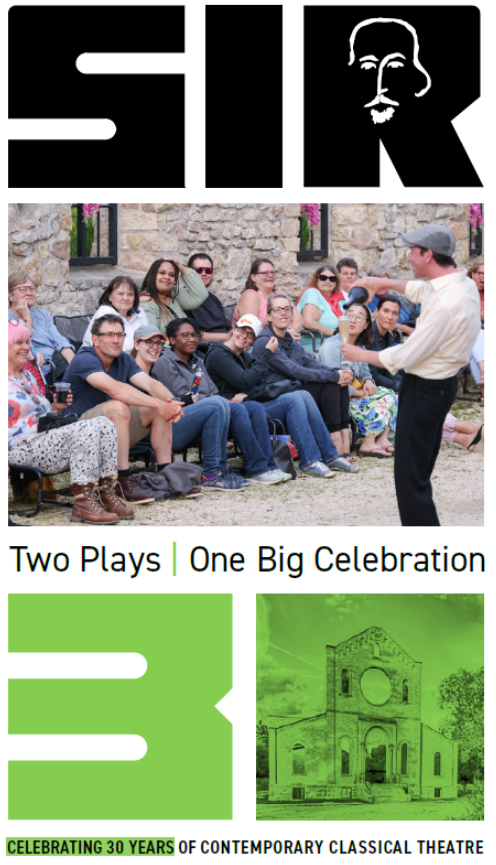
2023 Newsletter SIR’s 2023 season is about collaboration and celebration, with two distinct and delightful productions: Twelfth Night , arguably Shakespeare’s finest comedy, is filled with revelry and longing; while The Dark Lady , a world premiere of a new work by Jessica B. Hill is a dynamic duet that dismantles our conventional views on Shakespeare through the perspective of poetess Emilia Bassano – the possible ‘dark lady’ that appears in his sonnets. This ‘digital newsletter’ is your invitation to become intimately acquainted with this season through audio interviews, web chats, playlists & more.

2021 Newsletter

2019 Newsletter

2018 Newsletter

2017 Newsletter

2016 Newsletter